Gifted child guide
Gifted children struggling at school: when potential and results diverge
Having strong abilities does not mean a child has learned the material, understood expectations, organized their work, or been able to use their resources at the right moment.
Underachievement describes a gap between estimated potential and observed achievement. Its definition varies considerably across studies, however, requiring precision before speaking of “failure.”
The useful question is not only “Why are they not succeeding?” but where, since when, and under what conditions the gap appears.
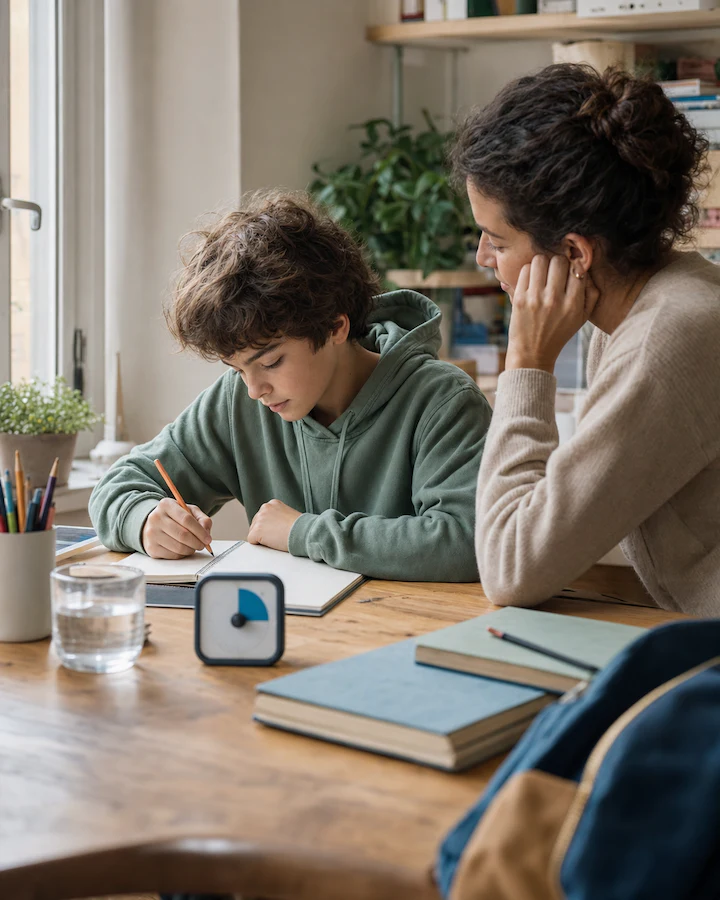
School results
High abilities do not automatically translate into consistent school results.
Potential, acquired learning, and performance: three different levels
Potential concerns reasoning or learning abilities. Acquired learning means the knowledge and skills actually developed. Performance is what appears in a particular task, with its instructions, time, grading, and the context of the day.
The systematic review by Raoof and colleagues includes 33 studies and describes internal and external factors: motivation, self-regulation, emotions, family, peers, school environment, and sociocultural context. It cannot predict the cause for an individual child.
Abilities
What the child may be able to understand or learn under certain conditions.
Learning
What they have actually practiced, memorized, and made available for use.
Performance
What they produce in a task, at a particular moment, and under specific expectations.

Take stock
Comparing successful and difficult tasks helps move beyond a general impression of failure.
Map the gap before looking for a cause
- the subjects, task types, and assessment formats involved
- when the change began and how results have evolved
- understanding of lessons and mastery of prerequisites
- methods, planning, starting, and submitting work
- sleep, health, anxiety, relationships, and life events
- possible attention or learning difficulties to explore separately
What do we know about interventions?
The synthesis by Steenbergen-Hu and colleagues of 14 studies found no significant overall improvement in academic performance, although small favorable effects appeared in psychosocial dimensions. Evidence quality was limited.
This encourages choosing support matched to the observed mechanism: explicitly teaching a method, adjusting the challenge level, supporting self-regulation, addressing an associated disorder, or changing the context. A single solution for all underachieving students is not supported.
Underachievement does not always mean failure
A student may earn passing grades yet learn far less than their resources would allow in a suitable setting. Conversely, poor grades do not prove underachievement linked to giftedness: they may reflect knowledge not acquired, a learning difficulty, a lack of methods, significant stress, or disrupted schooling.
Underachievement compares assumed or measured potential with expected performance. This comparison depends on the tools, period, and domain. A gap in spelling does not mean the same thing as an overall decline, work never submitted, or oral success that does not carry over into writing.
It is therefore more useful to map the gap than immediately seek a general cause. Where does the child succeed? Where do they struggle? What can they explain aloud? What work can they complete with support and then independently? This map turns an impression into a more precise educational and clinical question.
Mechanisms that can widen the gap
Learning that has long been easy may limit opportunities to develop study methods. When the level rises, children sometimes discover late that they need to review, plan, or tolerate not understanding immediately. The difficulty comes not from a loss of ability, but from study tools that remain fragile.
Motivation is not a stable reservoir either. It depends on the task’s meaning, expected feedback, sense of competence, and opportunity to act. Repeating “They could if they wanted to” ignores what prevents engagement and risks turning performance into a moral judgment.
A learning disorder, attention difficulty, anxiety, sleep, a health problem, or a difficult school environment may also contribute. Several factors sometimes reinforce one another: a misunderstood difficulty leads to avoidance, avoidance reduces practice, and growing gaps then increase the fear of trying again.
- Insufficiently developed methods and self-regulation.
- Poorly matched challenge or low perceived value of the task.
- A specific difficulty masked by compensatory strategies.
- Unfavorable stress, fatigue, relationships, or life circumstances.
Support without lowering or idealizing expectations
Helping a child means neither removing every difficulty nor constantly reminding them of their potential. Appropriate expectations combine an accessible challenge, explicit steps, and feedback on strategies. Children can learn that effort is not proof they are less capable, but a normal part of learning.
Adults can value what is controllable: asking for clarification, starting at the planned time, using an aid, checking an answer, or trying again after a mistake. Praising only speed and intelligence risks making difficulty more threatening and reinforcing avoidance.
When the gap persists, a meeting with the school and, if necessary, a targeted assessment can clarify needs. The aim is not to find a single explanation, but to build a response that examines teaching, methods, well-being, and any associated disorders together.
Understand different paths to underachievement
Underachievement may be longstanding or emerge at a transition to a new grade level. Some children achieve satisfactory results for a long time without study methods, then struggle when workloads increase. Others show a gap between oral reasoning and their work from the outset. These trajectories point to different mechanisms.
The gap may also be selective. A student invests in complex projects but neglects short exercises, succeeds in science but avoids languages, or understands a text without managing to write a summary. An overall average hides these contrasts and may lead to an overly general response.
Consequences develop in a chain. Unfinished work reduces teacher feedback; unconsolidated knowledge makes the next material harder; criticism increases tension; the child avoids more. Addressing even one link can change the trajectory before a complete explanation is available.
Families may unintentionally compensate for a substantial part of the child’s functioning: reminding them about every assignment, rephrasing instructions, sitting beside them, and checking all their supplies. This support sometimes maintains grades, but it should be described to assess actual independence and build a gradual transfer of responsibility.
Finally, progress should be judged through several indicators: assignments submitted, methods used, knowledge acquired, fewer conflicts, fatigue, and the ability to ask for help. Improved grades without independence or well-being may remain fragile; a more established method may precede visible improvement in results.
Scenario: results drop on entering middle school
Moving to several teachers, more homework, and greater independence can reveal fragile study methods. The child still understands quickly in class but forgets deadlines, does not review material, or cannot spread work over several days. The drop proves neither a loss of ability nor understimulation as the sole cause.
A shared calendar, a study method tested in one subject, and a limited weekly check-in can build missing skills without taking over all the organization. Results should be monitored alongside the family workload and fatigue.
If explicit tools do not reduce the burden, or specific difficulties emerge, exploring attention or learning becomes relevant. Increased demands may have revealed a longstanding need that was previously compensated for.
Create a sustainable plan for getting back on track
When there are many gaps, trying to catch up on everything at once increases the risk of giving up. The plan can choose one priority subject, one method, and a limited period. Other obligations are kept at a level compatible with available energy.
Goals should separate learning from administrative catch-up. Submitting overdue work may be necessary, but it does not always teach the missing knowledge. Some time should be reserved for understanding, practicing, and receiving feedback.
The child helps set priorities without carrying responsibility alone. They can identify the most urgent subject, what seems to block them, and the help they accept. Adults maintain the framework and check that the plan does not depend solely on that day’s motivation.
Breaks and preserved activities are not optional rewards. Sleep, movement, relationships, and experiences of competence support recovery. A program that fills every free moment risks increasing fatigue and opposition.
After a few weeks, the plan is adjusted using simple data. If no progress appears despite genuine implementation, the hypothesis should be reconsidered: the targeted difficulty, level of help, or presence of an associated disorder may have been misjudged.
Next step
01
Describe
identify a specific gap rather than a general impression
02
Test the hypotheses
separate knowledge, methods, motivation, health, and context
03
Coordinate
agree with the school on a trial and a follow-up review
Cereya Giftedness
An informative exploration, distinct from school results
Cereya Gifted Child offers an initial informative exploration of your child’s cognitive functioning through a parent questionnaire and brief age-appropriate exercises.
The assessment does not measure boredom, anxiety, learning, or self-esteem, does not report an IQ score, and replaces neither a professional assessment nor a conversation with the school.
- age-appropriate parent questionnaire
- brief cognitive exercises for the child
- results organized by dimension
- clearly explained assessment limitations
Initial summary included; detailed analysis available afterward.

Explore systematically
The Cereya assessment describes cognitive dimensions without explaining or diagnosing school failure.
FAQ
Frequently asked questions
Can a child be gifted and have poor grades?+
Yes. Grades do not directly measure intellectual potential: they depend on learning, methods, instructions, motivation, the child’s current state, and the school context.
Do poor grades mean giftedness was incorrectly identified?+
Not necessarily. They invite a check of what is being assessed and what is hindering performance. Only a professional process can reexamine identification when appropriate.
Does boredom explain a gifted child’s school difficulties?+
It can contribute to disengagement in some situations, but it is not a general explanation. Knowledge, strategies, attention, learning, and context should also be examined.
Can strong abilities mask a learning disorder?+
Some strengths can partly compensate for a difficulty and delay recognition. This cannot be inferred from a simple difference in grades and requires a targeted assessment.
Should the difficulty level be raised immediately?+
Only if observations show that the content is mastered and insufficient challenge is central. Otherwise, this may add demands without addressing the problem.
When should you explore further with a professional?+
When the gap persists, widens, comes with distress, or suggests an attention, emotional, or learning difficulty, an appropriate assessment can clarify needs.
References and resources
These reviews highlight the diversity of definitions, factors, and trajectories of underachievement.
- Raoof, K., Shokri, O., Fathabadi, J. & Panaghi, L. (2024). Unpacking the underachievement of gifted students: A systematic review of internal and external factors. Heliyon, 10(17), e36908. DOI: 10.1016/j.heliyon.2024.e36908. PMID: 39286082.
- Steenbergen-Hu, S., Olszewski-Kubilius, P. & Calvert, E. (2020). The Effectiveness of Current Interventions to Reverse the Underachievement of Gifted Students: Findings of a Meta-Analysis and Systematic Review. Gifted Child Quarterly, 64(2), 132–165. DOI: 10.1177/0016986220908601.
- Bucaille, A., Jarry, C., Allard, J., Brochard, S., Peudenier, S. & Roy, A. (2022). Neuropsychological Profile of Intellectually Gifted Children: A Systematic Review. Journal of the International Neuropsychological Society, 28(4), 424–440. DOI: 10.1017/S1355617721000515. PMID: 33998437.