Gifted child guide
Gifted children and boredom at school: understimulation or something else?
“I’m bored” may mean the exercise is already mastered, but also that it feels repetitive, uninteresting, hard to understand, or attentionally demanding.
For a child identified or thought to be gifted, understimulation is a plausible hypothesis in some situations. It is neither automatic nor enough to explain all school disengagement.
The aim is to move from a general impression to precise observations: in which subject, at what moment, with which task, and with what effect on the work?
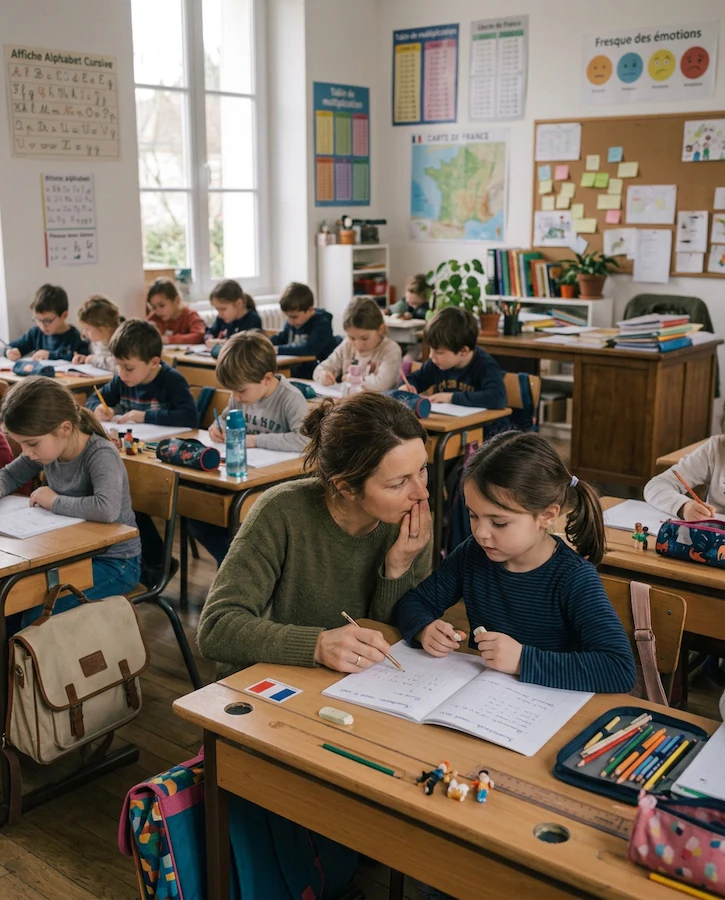
Boredom at school
Identifying exactly when boredom appears is more useful than immediately attributing it to giftedness.
Boredom is an experience, not a diagnosis
Research on school boredom shows that it depends, among other things, on the value attached to a task and the sense of control. It can appear when the challenge is too low, but also when a task seems inaccessible or meaningless.
The qualitative study by Smedsrud and colleagues gives voice to eleven mathematically gifted young people who followed accelerated pathways. Their accounts often connect boredom with insufficient challenge in math, but this very specific sample cannot be generalized to all gifted children.
Too easy
The content is genuinely mastered and repetition no longer offers a challenge.
Little value
The child does not see the task’s purpose or find it interesting at that moment.
Too demanding
Understanding, attention, fatigue, or a learning difficulty makes engagement hard.
Five observations that make the conversation useful
- the subjects and moments in which boredom appears
- what the child can actually do without help
- what changes when difficulty or choice increases
- the presence of fatigue, inattention, worry, or misunderstanding
- whether the same disengagement occurs in leisure activities or only at school

Observe the situation
Dated, contextualized examples help distinguish mastery, lack of interest, and difficulty.
What can you discuss with the school?
The conversation can begin with facts: mastered tasks, recurring errors, pace, participation, moments of disengagement, and reactions to more complex activities. The aim is not to obtain an adjustment solely on the basis of a label.
Depending on the situation, the team may consider greater depth, task choices, enrichment, differentiation, or checking for difficulties. The effects should then be observed, not assumed.
The different forms school boredom can take
Boredom is not always a complete absence of activity. A child may participate and achieve good results yet still experience repetition or time passing very slowly. Another may disengage, chat, or start drawing. A third may avoid starting because they anticipate an uninteresting task. These manifestations alone do not reveal the cause.
We can distinguish boredom related to insufficient challenge, boredom related to a lack of meaning, and boredom that appears when a task seems too demanding or hard to control. In the last case, children may say it is “stupid” or “boring” to protect themselves from misunderstanding, slowness, fear of mistakes, or considerable attentional effort.
Boredom also varies within the same subject. Discovering a concept may stimulate the child, while making it automatic feels repetitive. Yet repetition sometimes retains a real educational function: consolidating a procedure, improving accuracy, or freeing resources for more complex tasks. The aim is to adjust the amount, not remove all practice.
Understimulation, a hidden difficulty, or established disengagement?
When the difficulty decreases with a new, more complex task that the child actually succeeds at, understimulation becomes more plausible. If disengagement persists, instructions are misunderstood, or performance collapses whenever writing, memorizing, or organizing is required, other factors should be investigated.
Disengagement can also become a habit. After making little effort for a long time, the child may not have developed certain study methods or may struggle with the first real difficulty. Abruptly raising the level is then not enough: planning, asking for help, persisting, and accepting informative mistakes also need to be learned.
The social context matters too. A strained teacher–student relationship, fear of standing out, a sense of exclusion, or a noisy classroom can reduce engagement. Calling all of this understimulation would miss the factor actually maintaining the problem.
Insufficient challenge
The content is mastered and suitable deeper exploration restores engagement.
Hidden demands
Writing, attention, understanding, or fear of mistakes makes the task harder than it appears.
Context
The group, teacher–student relationship, or fatigue strongly changes readiness to participate.
When boredom begins to affect learning
Occasional boredom is part of school life. It becomes more concerning when it leads to lasting disengagement, absences, repeated conflicts, school refusal, a marked drop in results, or the child devaluing themselves. The impact matters more than how often the word “bored” is used.
At that point, examine what the child is no longer learning: knowledge, automatic skills, methods, the ability to sustain effort, or confidence when facing difficulty. Strong abilities may compensate for gaps for a while, then become insufficient as demands increase. This mismatch can explain a later drop in results without implying an automatic path toward failure.
A coordinated response can combine teaching adjustments, learning study methods, and exploring an associated difficulty. The aim is not to make every minute fascinating, but to restore a balance among challenge, meaning, manageable effort, and real progress.
Create a school–family observation plan
At home, parents often hear the overall account of the day; the teacher sees specific tasks. Connecting these perspectives avoids choosing between “bored everywhere” and “doing the work adequately.” A child may contain their disengagement in class and express their fatigue after school.
The plan can select two contrasting subjects and record the activity type, mastery, time taken to begin, persistence, and work quality for a few weeks. The child can give a simple rating for interest and perceived difficulty. The aim is comparable examples, not constant monitoring.
Adults should also observe moments of discovery. Does the child ask questions, accept an unfamiliar strategy, and try again after an error? If engagement disappears as soon as the answer is not immediate, the need may concern tolerance for effort as much as the level of content.
A successful adjustment does not eliminate every complaint. It should primarily increase new learning, improve engagement, and preserve necessary practice. A task remaining repetitive at times does not in itself mean the plan has failed.
If observations reveal a widespread burden, school refusal, physical symptoms, or a large gap between oral and written work, the discussion should broaden. The guide to underachievement or learning disorders can then help frame a more specialized question without treating boredom as the only cause.
Scenario: “I already know this,” but errors remain frequent
The child says they have mastered the lesson and are bored, while still making mistakes. They may know the principle without having made the procedure automatic, rush, misread instructions, or use boredom to protect their self-image. Mastery should be checked across several tasks, not inferred from their impression alone.
The teacher can reduce repetition after a brief mastery check and ask the child to explain their reasoning. If errors disappear with clear instructions and a greater challenge, the adjustment is informative. If they persist, precision and method need work.
The child can then receive a consistent message: their need for challenge is heard, but learning also includes consolidation and checking. The aim is not to choose between boredom and effort, but to adjust each to the actual skill level.
Avoid three responses that sometimes make the problem worse
Systematically assigning more of the same rarely rewards speed. The child may learn that finishing quickly only leads to a larger quantity and start slowing down or hiding mastery. Deeper exploration should replace some already-mastered work rather than be added without limit.
Removing all repetition is the opposite mistake. Some procedures need to become automatic, and children must learn to distinguish useful consolidation from excessive repetition. A shared mastery criterion makes this distinction less arbitrary.
Finally, promising that class will always be interesting creates an impossible expectation. School includes transitions, exercises, and group constraints. Support aims for a reasonable amount of challenge and meaning, along with strategies for getting through less stimulating moments.
Consequences alone may also miss the cause. They may stop chatting without restoring learning. A behavioral boundary is sometimes still necessary, but it should come with an understanding of the task and an acceptable alternative.
A balanced response therefore combines the child’s responsibility with that of the setting. The child engages, takes care with their work, and communicates; the school checks mastery, adjusts the challenge, and examines other obstacles when they persist.
A reasonable next step
01
Take notes
gather two or three specific situations over a few weeks
02
Compare
compare the child’s experience with the teacher’s observations
03
Try
try a limited adjustment, then examine what actually changes
Cereya Giftedness
Explore cognitive functioning without claiming to explain boredom
Cereya Gifted Child offers an initial informative exploration of your child’s cognitive functioning through a parent questionnaire and brief age-appropriate exercises.
The assessment does not measure boredom, anxiety, learning, or self-esteem, does not report an IQ score, and replaces neither a professional assessment nor a conversation with the school.
- age-appropriate parent questionnaire
- brief cognitive exercises for the child
- results organized by dimension
- clearly explained assessment limitations
Initial summary included; detailed analysis available afterward.

Initial exploration
An informative assessment can structure questions without identifying the cause of school boredom.
FAQ
Frequently asked questions
Are all gifted children bored at school?+
No. School experiences vary widely. Some children report boredom in certain tasks, while others remain engaged or experience different kinds of difficulties.
Is a bored child necessarily ahead?+
No. Boredom can also relate to a lack of interest, a poorly understood task, fatigue, attention, relationship context, or a learning difficulty.
Can boredom lead to poor grades?+
It can contribute to disengagement, but a grade also depends on knowledge, methods, instructions, self-regulation, and context. The gap should be examined rather than assuming an automatic trajectory.
Should you ask for more difficult exercises?+
This can be a relevant trial if the content is truly mastered. The adjustment should be proportionate, discussed with the school, and evaluated through its effects on learning and well-being.
How can you distinguish boredom from an attention difficulty?+
Look at whether attention returns with a more stimulating task, whether difficulties occur across settings, and whether they persist even when the child is interested. Observation alone does not allow a conclusion.
When should you seek professional advice?+
When disengagement persists and comes with distress, school refusal, or significant difficulties, a conversation with the school and then an appropriate professional can help broaden the analysis.
References and resources
Evidence specific to giftedness remains limited; it is supplemented by general research on school boredom.
- Smedsrud, J. H., Nordahl-Hansen, A. & Idsøe, E. (2022). Mathematically Gifted Students’ Experience With Their Teachers’ Mathematical Competence and Boredom in School: A Qualitative Interview Study. Frontiers in Psychology, 13, 876350. DOI: 10.3389/fpsyg.2022.876350. PMID: 35707664.
- Pekrun, R., Goetz, T., Daniels, L. M., Stupnisky, R. H. & Perry, R. P. (2010). Boredom in Achievement Settings: Exploring Control–Value Antecedents and Performance Outcomes of a Neglected Emotion. Journal of Educational Psychology, 102(3), 531–549. DOI: 10.1037/a0019243.
- Raoof, K., Shokri, O., Fathabadi, J. & Panaghi, L. (2024). Unpacking the underachievement of gifted students: A systematic review of internal and external factors. Heliyon, 10(17), e36908. DOI: 10.1016/j.heliyon.2024.e36908. PMID: 39286082.
Explore further